Radiative Cooling Paint
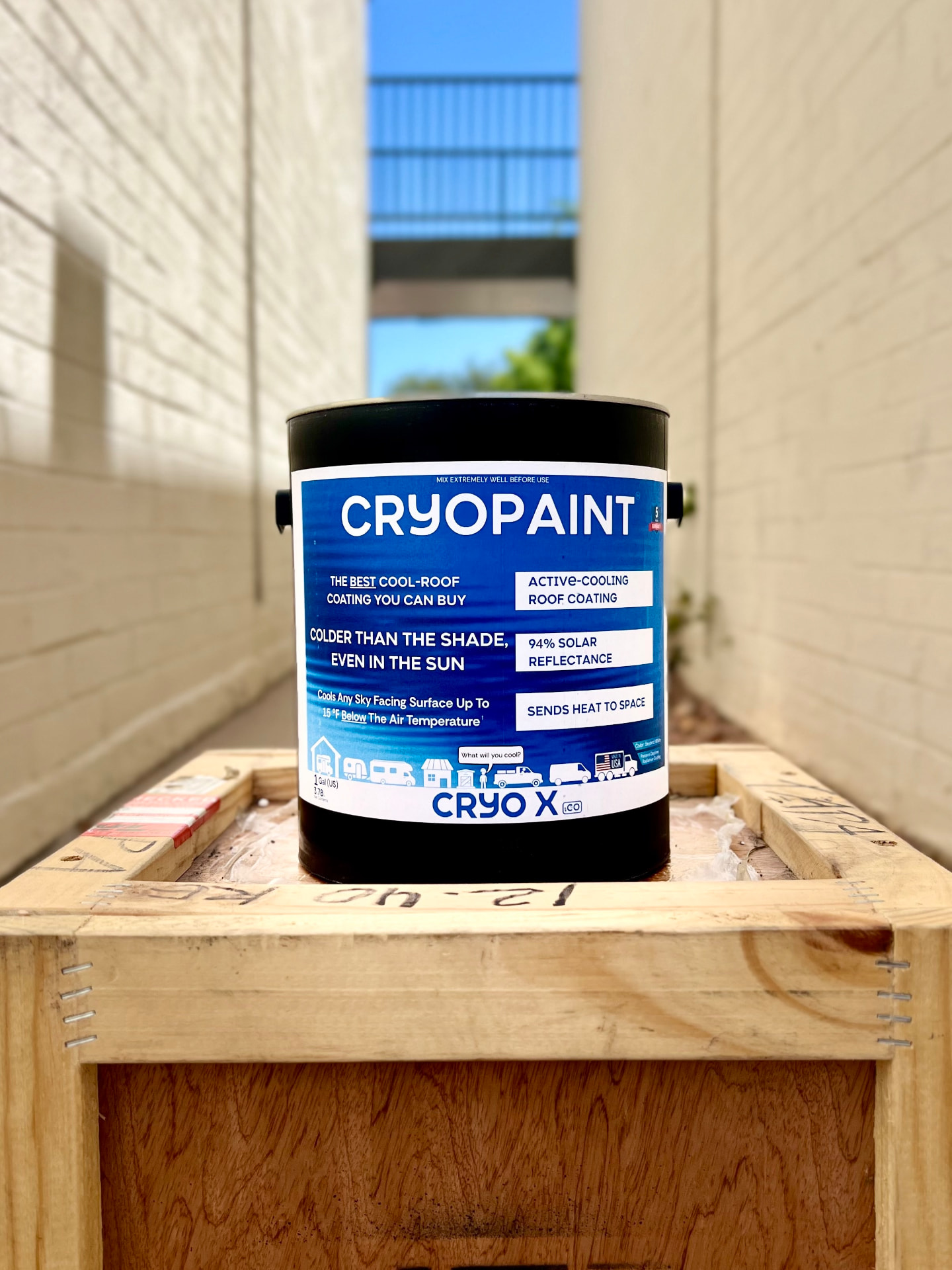
CryoPaint® - Passive Daytime Radiative Cooling (PDRC)
Sprayable water-based passive daytime radiative cooling (PDRC) coating that actively cools outdoor surfaces up to 15°F below air temperature, even in direct sunlight
Bulk and wholesaler pricing available. Contact us.
Solar Reflection
Thermal Emission
Sq Ft per Gallon (at 1 oz / sq ft)
Values measured at the 1 oz / sq ft minimum rate over a white primer base coat. Heavier coats measure slightly higher.
Case Studies
*Hard Hat Testing Report: painting a hard hat does not hurt the shell, but primer choice matters. See the hard hat FAQ for primer chemical compatibility and safety notes before applying.
Looking for the full product specs? View the complete CryoPaint installation guide →
CryoPaint® Active-Cooling Paint
CryoPaint® is a low-VOC, water-based passive daytime radiative cooling (PDRC) coating that actively cools outdoor surfaces up to 15°F below air temperature. Just paint it on and feel the difference.
How It Works
Applied to any relatively flat, sky-facing surface with little-to-no insulation beneath, the paint reflects 94% of sunlight and has 90% 8–13 µm emissivity - in the wavelengths that bypass the atmosphere, it radiates its own heat to space at 90% of the maximum rate possible - acting like a heat-sink for buildings, vehicles and equipment.
An outside lab ran it through 1,500 hours of accelerated weathering. See the test results.
Color: Beyond White (matte)
Stock CryoPaint comes in Beyond White - a matte, bright, neutral-warm white optimized for 94% solar reflectivity. It is highly reflective like a cloud, not like a mirror: no gloss, no shine, no glare. Do not tint or mix with other paints/pigments.
Custom colors are now in beta
We can make custom colors on a per-order basis for your project or use case. We will work with you to get close to your requested color while delivering very good performance. Pricing and lead times differ from stock Beyond White CryoPaint.
Ask about a custom colorWorks on Most Rigid Surfaces
Adheres to virtually any clean, primed, rigid exterior substrate - including painted metal roofs, aluminum, galvanized panels, EPDM/TPO membranes, asphalt roll roofing, concrete, masonry, wood, fiberglass, and most hard plastics when used in conjunction with a surface appropriate primer. CryoPaint is flexible enough to move with normal thermal expansion and contraction, but it is not plastic. Do not apply it to fabrics, tarps, or anything that rolls or folds.
Surface Preparation
Most applications only require basic cleaning with water, however if the material you plan to paint is prone to rust, we highly recommend putting a rust blocking primer layer down first on problem areas. If the surface is extremely glossy or hydrophobic, prep it with heavy sanding and a more aggressive primer. Scratch test your primer before applying CryoPaint.
Application Requirements
An airless paint sprayer is our #1 recommended method - apply at 1 oz / sq ft in a single coat for the fastest, best-performing finish. In hot, windy, or very dry conditions, split that 1 oz / sq ft target into two or more thinner coats (for example, 0.5 oz/sq ft, wait 30 to 45 minutes, then another 0.5 oz/sq ft) so the paint can't flash-dry and crack. For smaller or simpler projects, you can roll it on with a 3/8-inch nap polyester roller rated for all paints and thick paints. A roller lays down about 0.3 oz / sq ft per coat, so the rolled minimum is 3.5 coats (three to build the film, then a half coat that finishes the surface and empties the roller; buy at 1¼ oz / sq ft to cover tray and roller loss), and about 6 to 7 total coats (about 2 oz / sq ft, our recommended rate) gives the best rolled performance, 30 to 45 minutes between coats. See the full CryoPaint installation guide for more detailed information.
Low Maintenance
Self-cleans with water. You can use either natural rainfall or a hose. You can paint over CryoPaint if you feel you need a touch-up, or if there is cosmetic damage. You can always paint over it with a thicker coat, which also improves performance and extends longevity.
Optimal Conditions
Clear blue sky, low humidity, and still air. Wind matters more than most people expect: convection drags the surface temperature back toward the air temperature, so sustained wind above 5 mph noticeably reduces cooling (breezes and gusts are fine). Surface should be relatively flat, sky-facing, and have little-to-no insulation beneath for best active cooling. See detailed environmental factors for more information.
Always use a primer!
Use a matte white primer base coat for best results; We recommend always priming with any off-the-shelf matte white primer before applying CryoPaint. It is not strictly required, but every time a customer has an issue, it usually has to do with not using a primer.
Do your research to make sure the primer you choose is compatible with your substrate (asphalt roofs need a bleed-blocking primer, some solvent-sensitive plastics do not work well with certain spray-can primers). A white primer is also required for coverage under the CryoPaint Limited Warranty.
New to CryoPaint? Start with the CryoPaint Installation Guide
Whether you bought a sample, quart, gallon, or 5-gallon - prep, primer recommendations, coverage rates, recommended sprayers, drying, and performance tips all live in one place.
Open the CryoPaint Installation GuideBulk and wholesaler pricing available. Contact us.
Real-World Results
CryoPaint roof vs. side exterior shade
CryoPaint in direct sun (77.7°F) vs the shaded side (90.7°F).
Bulk and wholesaler pricing available. Contact us.
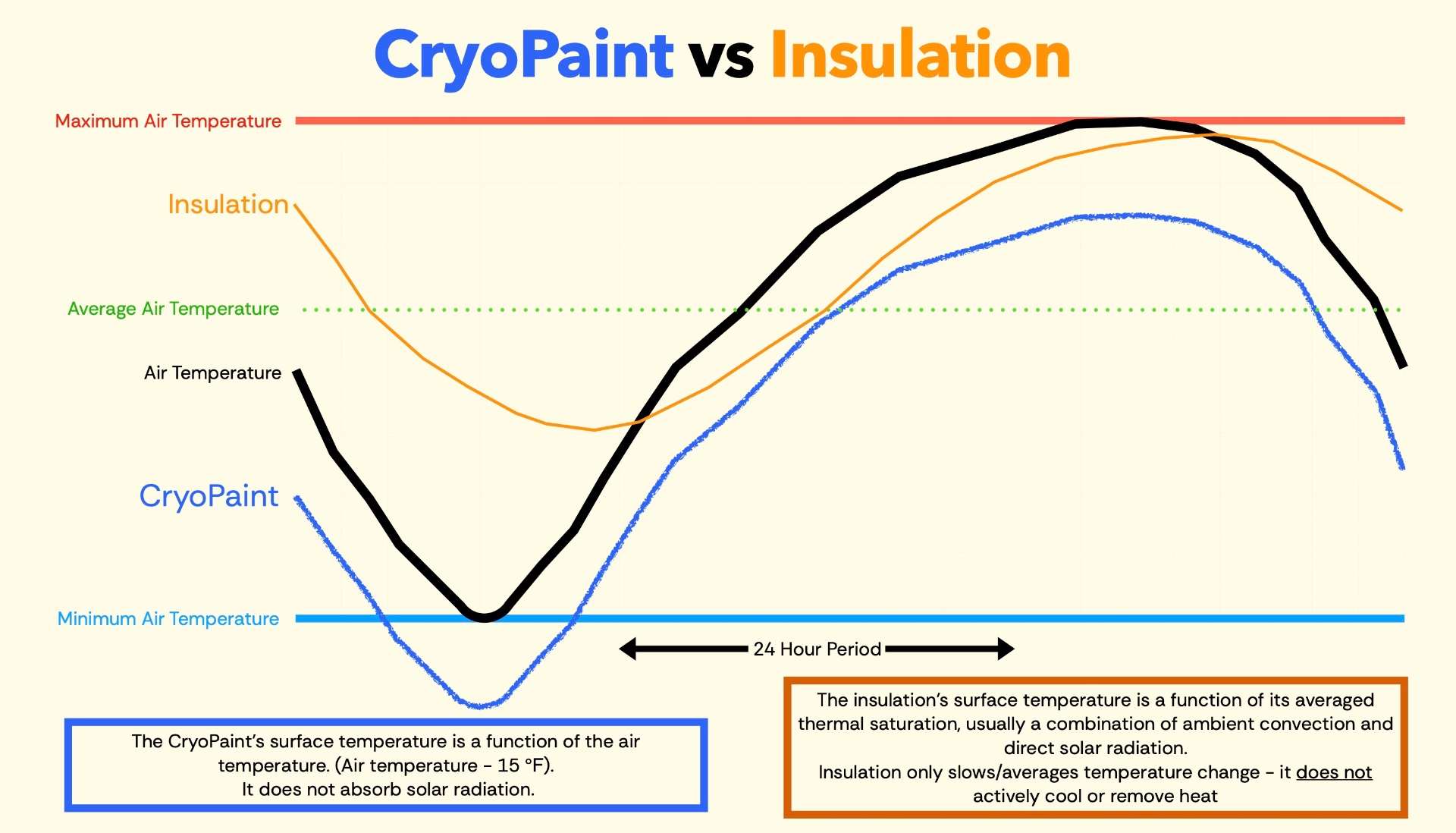
CryoPaint
Actively cools surfaces up to 15°F below air temperature through radiative cooling, working instantly to remove heat to space
Traditional Insulation
Only slows temperature changes and averages them out - cannot actively cool or remove heat from the system
How CryoPaint Compares
How hot each kind of roof actually gets on a 100°F summer day, in full sun with little wind, measured on top of the roof in the middle of the afternoon. Each bar runs from the coolest to the hottest reading published for that material.
Test conditions. A 100°F day, clear sky, light wind, mid-afternoon, measured on the top surface of the roof in direct sun. No indoor, attic, under-deck or shaded readings.
Method. Peak surface temperatures from published field measurements, adjusted to a common 100°F day using the air temperature each study recorded alongside its own reading. Bare metal is quoted directly from the EPA. Every figure is cited below.
Application Methods
CryoPaint can be applied using standard equipment, making it accessible for both professionals and DIY users.
Spray Application - Recommended Method
For optimal results and aesthetics, we strongly recommend using an airless paint sprayer. Apply at our standard rate of 1 oz / sq ft in a single coat. Corrugated and other three-dimensional roofing surfaces need 30% to 50% more paint per flat sq ft, depending on how deep the ribs are. Shallow ribs sit near 30%, deep or steeply corrugated roofs need the full 50%.
Hot, windy, or very dry conditions? Split the 1 oz / sq ft target into two or more thinner coats to prevent cracking. For example, near 85°F: ½ oz / sq ft, wait 30 to 45 minutes, then another ½ oz / sq ft to reach 1 oz / sq ft total. Your total target rate is the same.
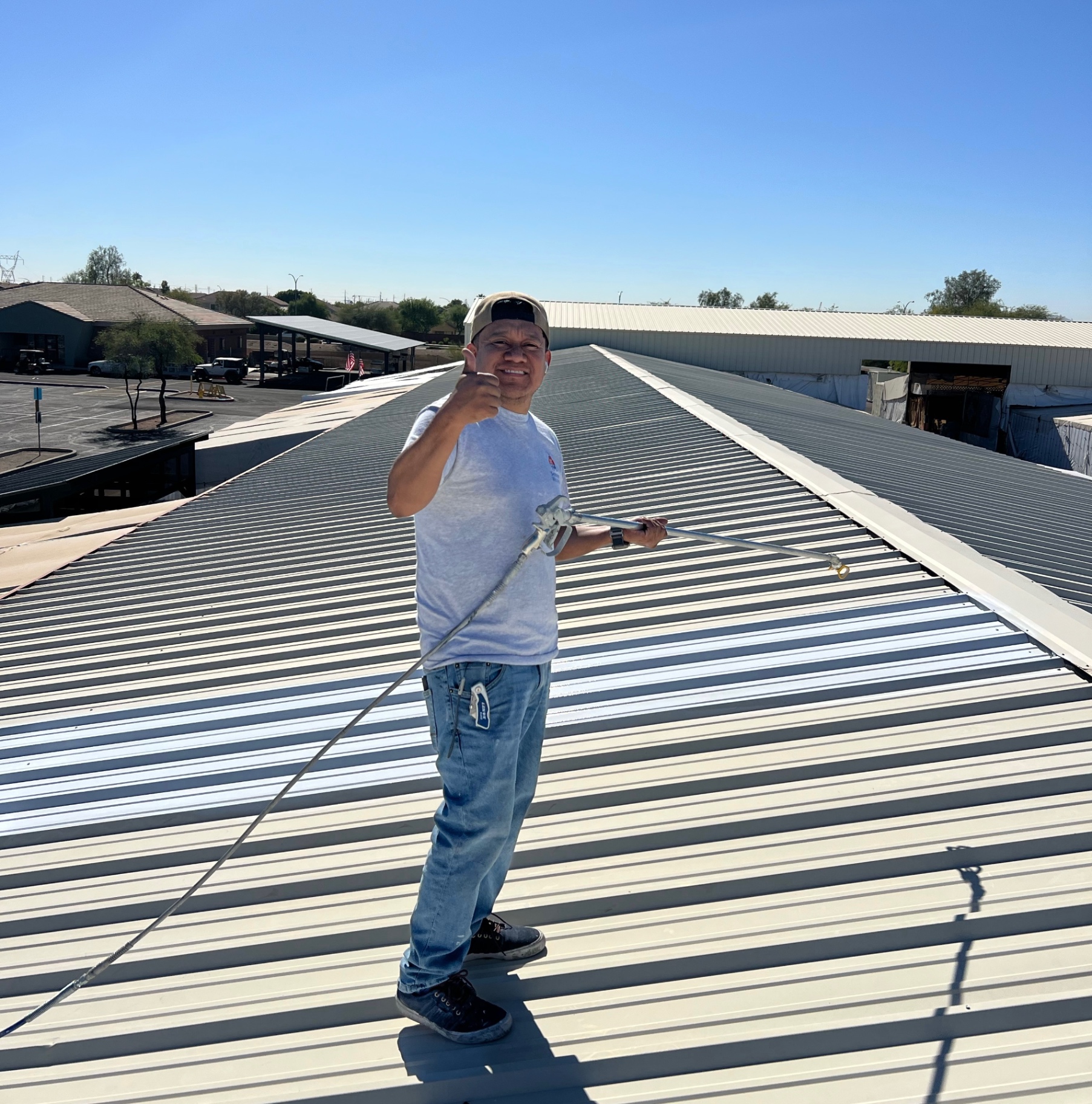
Note: HVLP systems, squirt guns, and brushes are not approved methods - the paint is too viscous. Always test your sprayer with water before use. Cryo X is not responsible for damaged or broken equipment.
Roller Application - Smaller & Simpler Projects
For smaller or simpler projects CryoPaint can be applied with a paint roller. Pour the paint into a roller tray, load the roller from the tray, and roll it onto the surface. Do not dump or pour paint directly onto the surface and try to smooth it out with the roller. Use a 3/8-inch nap polyester paint roller rated for all paints and thick paints (also marketed as suitable for paints and stains).
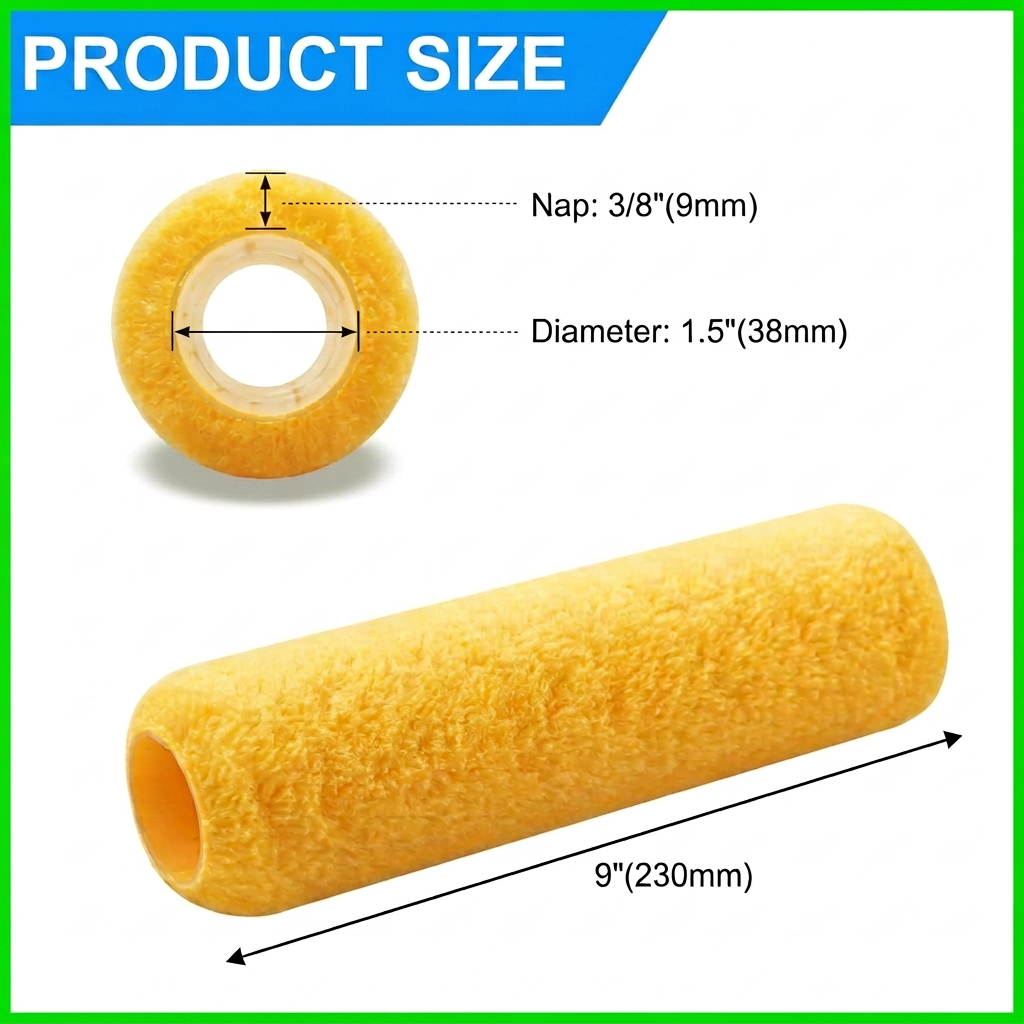
A 3/8-inch nap polyester roller rated for all paints and thick paints.
- A 3/8-inch nap roller lays down about 0.3 oz / sq ft per coat. The rolled minimum is 3.5 coats: three coats build the film, and a final half coat finishes the surface and works the last paint out of the roller, a solid 1 oz / sq ft laid down. Plan purchases at 1¼ oz / sq ft to cover what the tray and roller cover keep.
- Really good results start around 2 oz / sq ft, our recommended rate - about 6 to 7 total coats.
- Wait 30 to 45 minutes between coats. Spreading the coats over two or three days is fine: 3 coats one day, 3 the next, then the finisher.
- Keep a wet edge and roll in consistent directions to minimize lap marks.
- An airless sprayer reaches the same rate in one or two coats with a smoother finish. The Graco TrueCoat 360 below is our default pick for small jobs, and a cart-style airless for building-scale work. The roller remains an approved option. Either way the paint and the rate are the same. See the recommended equipment below.
Brushes are not an approved application method for CryoPaint.
Recommended Equipment
Not every sprayer can handle the elevated viscosity of CryoPaint.
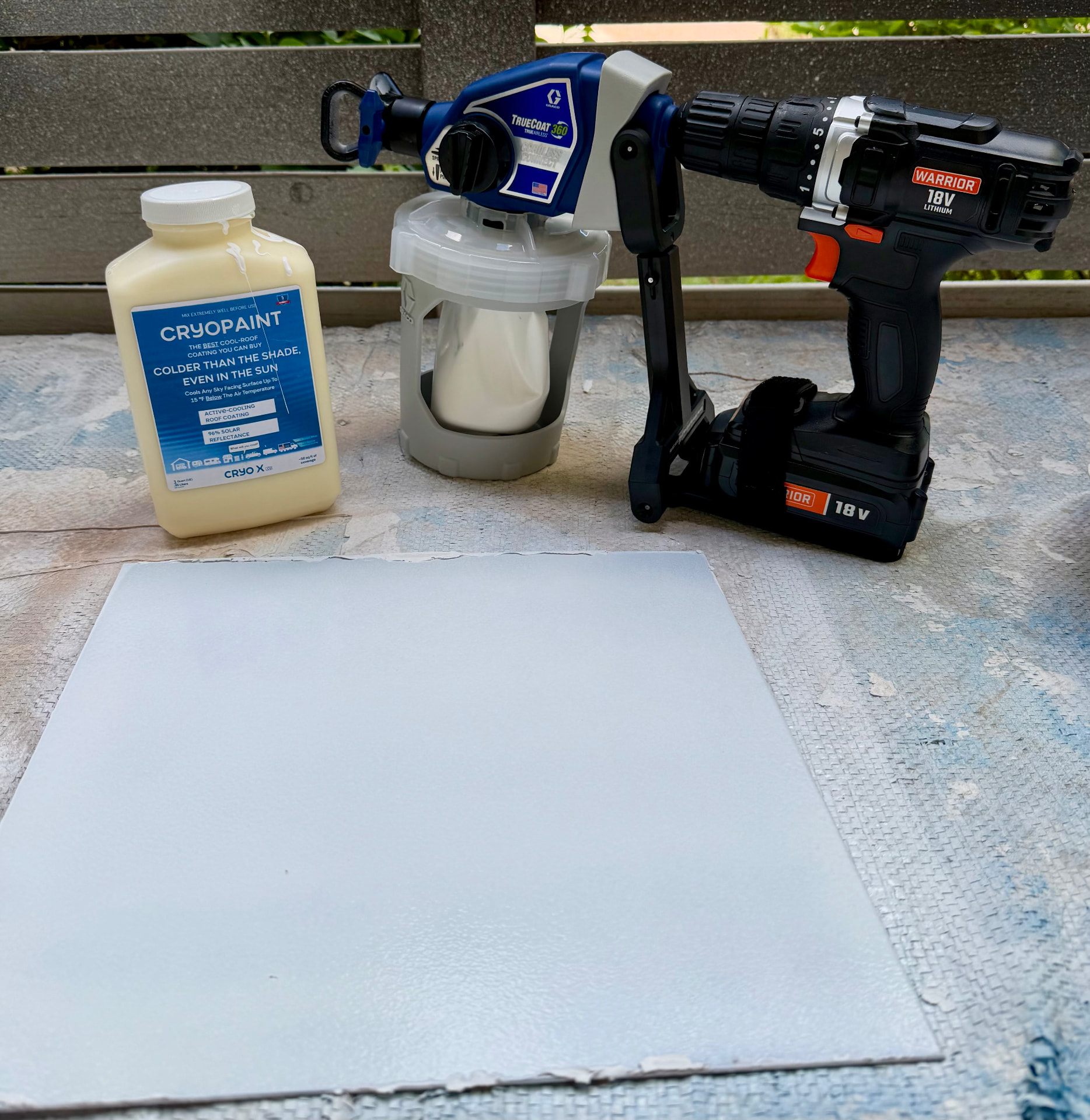
The Graco TrueCoat 360 Handheld Cordless Connect Drill Paint Sprayer is the best choice for everything below building scale: vehicles, RVs, trailers, containers, sheds, hard hats, coolers, panels, and test patches. It is a true airless handheld that runs off a standard cordless drill. It is not an HVLP or turbine gun and it has no built-in blower, so none of the warnings further down apply to it. CryoPaint sprays extremely well through it and the finish is excellent.
Pour a quart straight into the cup and go. You can run a full gallon through it by refilling the cup as you work. It is small, light, and sold at most paint and home improvement retailers for under $200, sometimes as low as $169.
We recommend it over a roller at this size: it lays the full rate in one or two passes instead of six or seven coats. Step up to a cart-style airless only when you move to building-scale work such as full roofs and warehouses. Flush it with clean water immediately after use.
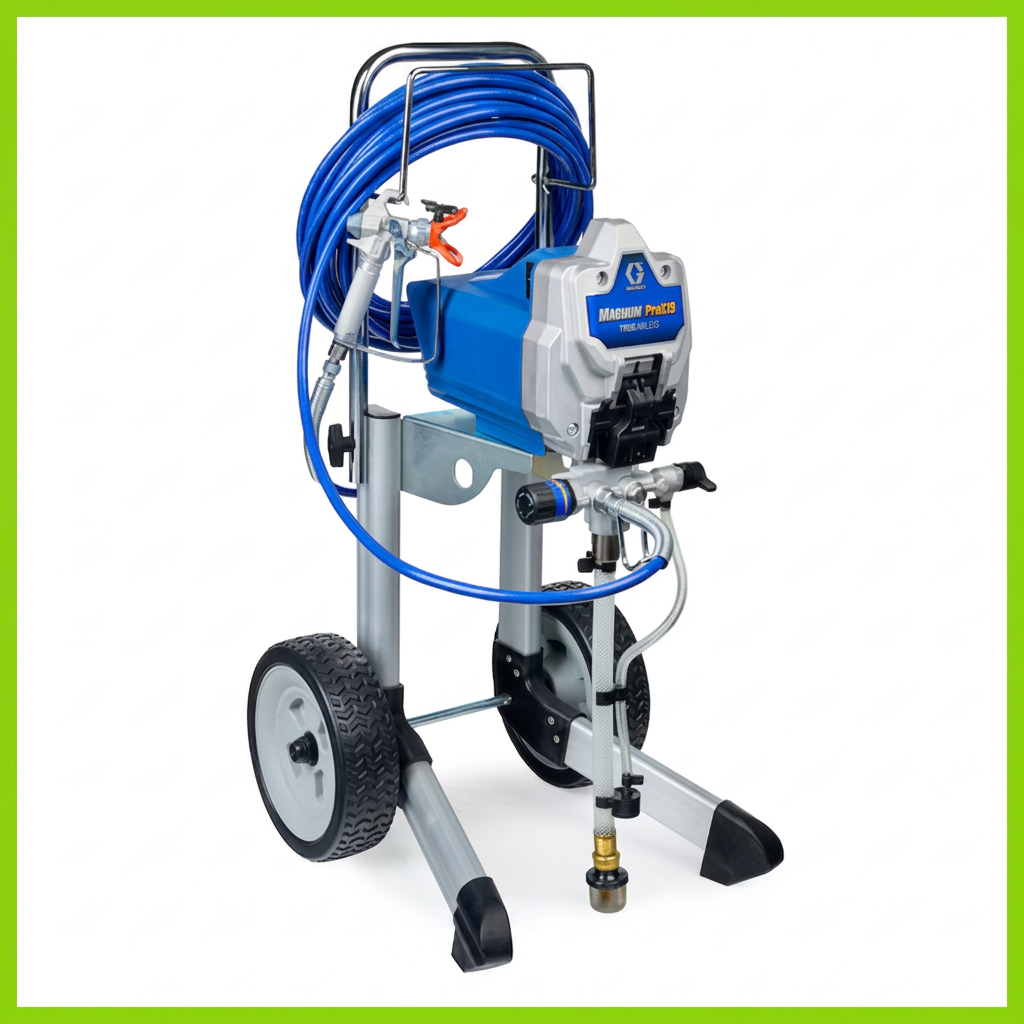
Once you are painting at building scale - full roofs, walls, warehouses, or repeat commercial work - a cart-style true airless paint sprayer like the one pictured is the right tool. It has enough pressure and flow to move thick paint without clogging, so you can cover real square footage without fighting the equipment. If you cheap out on budget or knock-off versions, you may encounter issues, as those often lack the power to move thick paints.
Tip size matters as much as the machine. CryoPaint is thick and heavily loaded with solids, so run the largest tip your sprayer supports. A 517 is the right starting point for the 390 PC, a 515 or 517 for the ProX19, and a 519 or larger for the 490 XT.
Large Volume
- Graco Ultra 490 XT Airless Sprayer
Pro-grade stand or cart sprayer for large roofs, warehouses, and repeat use. Run a 519 tip or larger, and the largest orifice your unit supports.
Medium Volume
- Graco 390 PC Airless Sprayer
Solid pro workhorse for residential and medium-size jobs. Run a 517 tip or larger to keep thick paint moving.
Entry-Level Building Scale
- Graco Magnum ProX19 Cart Airless Sprayer
Entry-level cart-style true airless for small jobs and touch-ups where refilling a handheld cup would slow you down. Run a 515 or 517 tip.
For smaller or simpler projects where you would rather not buy or rent a sprayer at all, a 3/8-inch nap polyester paint roller rated for all paints and thick paints is an approved method. Pour the paint into a roller tray, load the roller from the tray, and roll it onto the surface. Do not dump or pour paint directly onto the surface and try to smooth it out with the roller.
A 3/8-inch nap roller lays down about 0.3 oz / sq ft per coat, so the rolled minimum is 3.5 coats: three coats build the film, then a half coat finishes the surface and empties the roller, a solid 1 oz / sq ft laid down (plan purchases at 1¼ oz / sq ft to cover tray and roller loss). For better performance, keep going to about 6 to 7 total coats - about 2 oz / sq ft, our recommended rate. Allow 30 to 45 minutes between coats, and it is perfectly fine to spread them out: 3 coats one day, 3 the next, then the finisher. If you have leftover paint, use it - thicker coats perform better and last longer. Keep a wet edge and roll in consistent directions to minimize lap marks. An airless sprayer reaches the same rate in one or two coats, which is why it stays our first recommendation for larger jobs.
Never use - HVLP and turbine sprayers
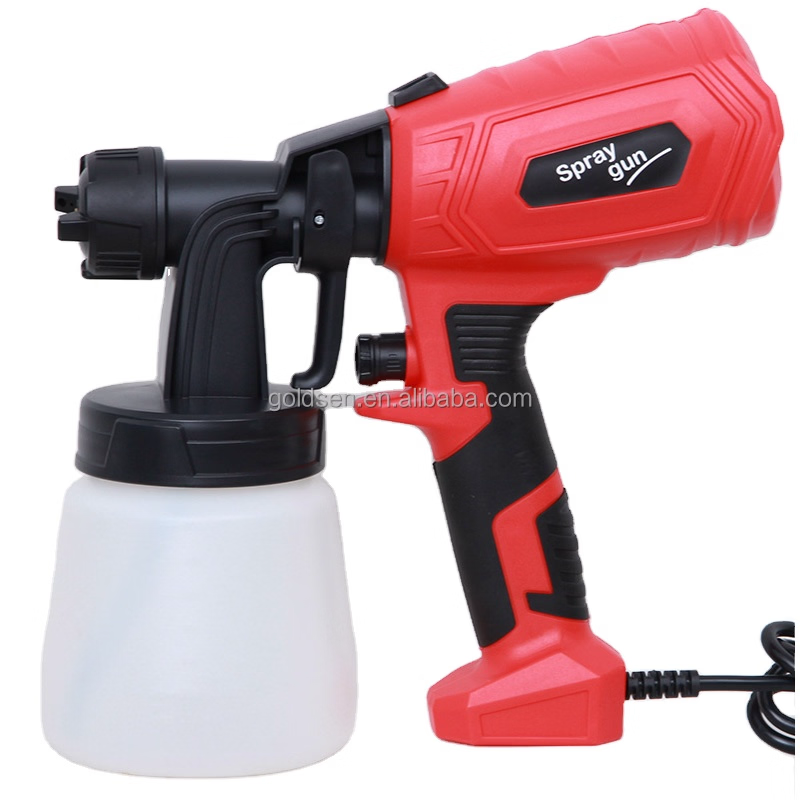
CryoPaint is too viscous for HVLP and turbine-driven systems. They cannot atomize it properly, they clog constantly, and they cannot deposit the film thickness the coating needs. This applies to every HVLP unit regardless of brand or nozzle attachment.
Handheld all-in-one guns that house the blower inside the gun (pictured) are the worst case. They heat the air too quickly, and it does not have time to cool before hitting the paint. This fries the coating mid-air, causing premature cracking of the finish and damage to the unit.
After you spray - flush immediately
CryoPaint is water based, so cleanup is water only, but do it right away. The coating is heavily loaded with barium sulfate, which is abrasive and will wear sprayer packings faster than ordinary latex paint. Flush the pump, hose, and gun with clean water immediately after use, before the coating begins to cure. Do not let it sit in the machine.
Choose Your Rate
Every gallon is the same paint. The rate you apply it at is the real product decision: it sets your cost per square foot, your coat count, and how much performance and lifespan you get.
| rate | $ per sq ft | sq ft per gallon | roller coats | what you are buying |
|---|---|---|---|---|
| 1 oz / sq ft sprayed minimum | $1.95 / sq ft | 128 sq ft | sprayer, 1 coat | The minimum for spraying. Expect 0 to 5°F below air temp. (Meaning at or below air temp, even in direct sunlight) |
| 1¼ oz / sq ft rolled minimum | $2.44 / sq ft | 102 sq ft | 3.5 coats | The minimum for rolling. A roller lays about 0.3 oz per coat, so this is the honest entry point without a sprayer. |
| 1½ oz / sq ft corrugated | $2.93 / sq ft | 85 sq ft | 5 coats | Ribbed and corrugated surfaces need 30% to 50% more paint than a flat roof to match it. Shallow ribs land near 1.3 oz, deep ribs need the full 1.5. |
| 2 oz / sq ft recommended | $3.90 / sq ft | 64 sq ft | 6 to 7 coats | Where results get really good: noticeably less absorbed sunlight, margin against wear, and longer life. The rate we use for our own demos. |
| 3 oz / sq ft maximum | $5.85 / sq ft | 43 sq ft | 10 or more coats | The last increment of performance plus maximum durability. Best on small, high-value surfaces. |
Prices at the $250 gallon. Each step up absorbs less sunlight, but the steps shrink: 1 to 2 oz is a meaningful jump, and 2 to 3 oz buys a smaller final increment plus durability. More paint never means proportionally more degrees. Whatever the rate, apply it in coats of 1 oz/sq ft or less, 30 to 45 minutes apart. Rolled rates are buying numbers: the 3.5-coat rolled minimum lays a solid 1 oz on the surface, and the rest covers what the tray and roller cover keep. That loss shrinks on bigger jobs, but big jobs are where a sprayer saves you hours anyway.
Try CryoPaint with a removable test option
We do not sell a film or sticker version, but you can build your own removable test surface for about $50 on Amazon. Apply 3M 2080 M10 automotive vinyl to a small, clean, flat object, paint the entire vinyl-covered area with CryoPaint, and peel it off when you are done.
- CryoPaint 4 oz sample
- 3M 2080 M10 automotive vinyl, 5 ft x 1 ft
- Linzer MT101 3/8-inch nap polyester roller
Important: paint the entire test object or panel. A small patch on a larger metal surface will not show the cooling effect because the uncoated metal overwhelms the painted area. See the FAQ for the full explanation.
RV & Mobile Home Owners
Looking to cool your RV or mobile home roof? Our sister site www.getcryox.com offers specialized discounts and detailed guides specifically for these applications.
Upgrade Your Surfaces with CryoPaint®
Only $1.95 / sq ft - What will you cool?
🌍 Now accepting international orders via cryox.us
Bulk and wholesaler pricing available. Contact us.
*An airless paint sprayer is our number one recommended application method. The standard rate is 1.0 oz/ft², which is the minimum thickness and the rate our published performance figures are measured at. Heavier coats up to 3.0 oz/ft² give incrementally better cooling and better durability, with diminishing returns above roughly 2 oz. Corrugated roofs should be applied at 1.3 to 1.5 oz/ft², depending on rib depth, with steeply corrugated roofs at the top of that range, since the ribs add real surface area compared with a flat top-down measurement. If a sprayer is not available, roll it on with a 3/8" nap polyester roller rated for thick paints. Pour the paint into a roller tray, load the roller from the tray, and roll it onto the surface. Do not dump or pour paint directly onto the surface and try to smooth it out with the roller. A 3/8" nap roller lays down about 0.3 oz/ft² per coat, so the rolled minimum is 3.5 coats on a flat surface (about 1 oz/ft² laid down; plan purchases at 1.25 oz/ft² to cover tray and roller loss), and about 6 to 7 total coats for the best rolled performance. On a corrugated roof, plan on 30% to 50% more than that, so about 5 coats minimum. Wait 30 to 45 minutes between coats; spreading the coats across two or three days is fine. If you have any paint left over, use it to make your coat even thicker - thicker coats perform better and last longer. It is an estimate, not an exact figure, because it depends on how deep the corrugation is. Any rate above 1 oz/ft² must be applied in multiple coats. Contact Cryo X directly if you have questions about how CryoPaint will perform on your roof.