How Passive Daytime Radiative Cooling Works
Passive Daytime Radiative Cooling (PDRC) is a physics effect that emits heat through the 8–13 µm atmospheric transparency window directly to outer space, cooling surfaces below air temperature.
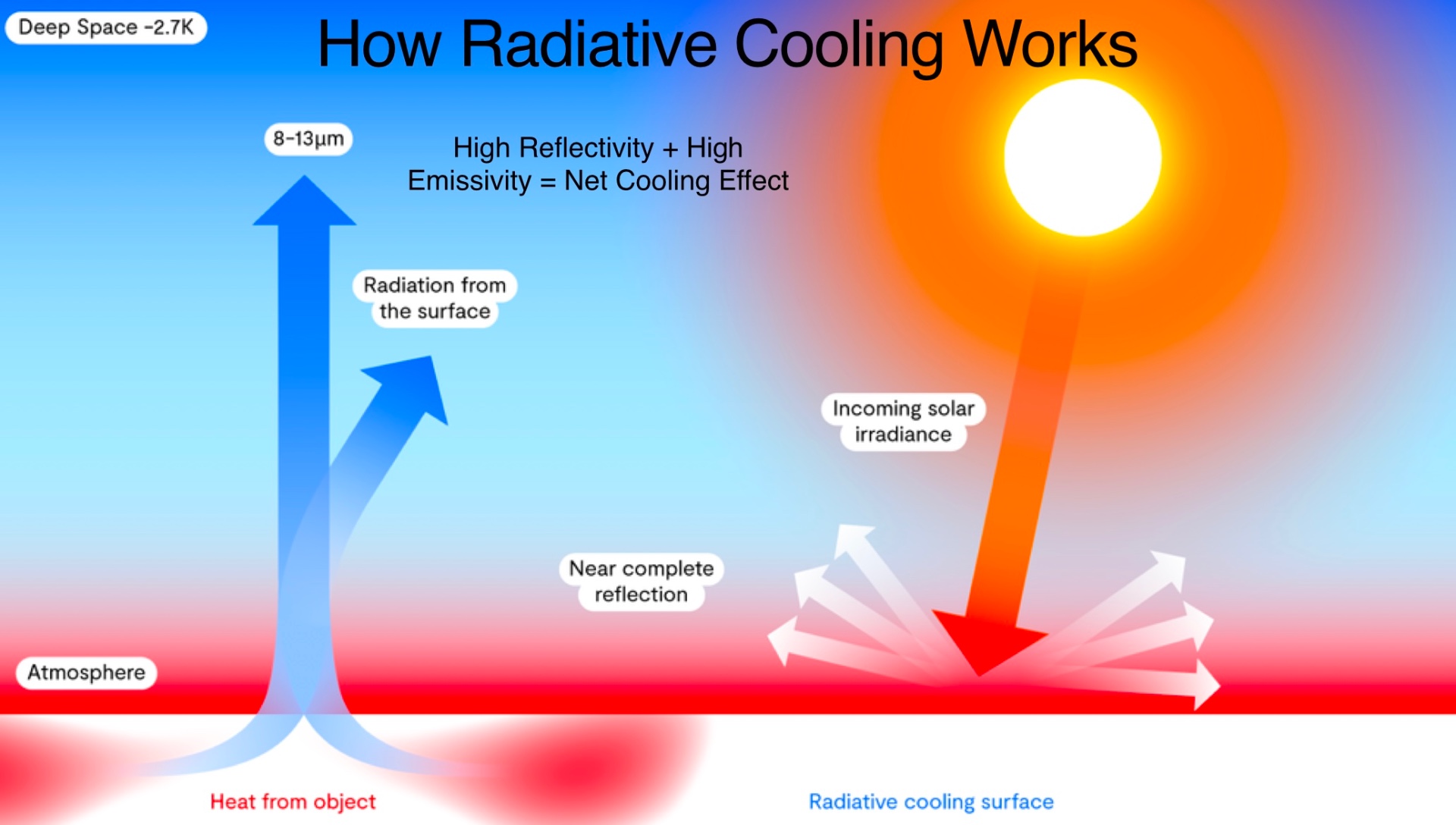
Diagram showing how CryoPaint achieves passive radiative cooling
The Science of Radiative Cooling
CryoPaint creates a cooling effect through two key physical mechanisms:
High Solar Reflectivity (94%)
CryoPaint reflects 94% of incoming solar radiation across the visible, UV, and near-infrared spectrum. This prevents surfaces from heating up during the day. Most cool roof coatings land in the 80 to 88 percent range. See how it held up after 1,500 hours of accelerated weathering.
High 8–13 µm Emissivity (90%)
CryoPaint has 90% 8–13 µm emissivity, meaning in the wavelengths that bypass the atmosphere, it radiates its own heat to space at 90% of the maximum rate possible. That tuned emission, together with the 94% reflectivity, is what lets a surface drop below air temperature. Most cool roof coatings have a broad emissivity that absorbs heat from the atmosphere (downwelling).
Values measured at the 1 oz / sq ft minimum. Thicker coats have better performance.
Net Energy Loss
The combination of high solar reflectivity and high emissivity in the 8–13 µm atmospheric transparency window creates a net energy loss, allowing surfaces to cool below ambient temperature with no moving parts at roughly -100 W/m2
How CryoPaint Compares
How hot each kind of roof actually gets on a 100°F summer day, in full sun with little wind, measured on top of the roof in the middle of the afternoon. Each bar runs from the coolest to the hottest reading published for that material.
Test conditions. A 100°F day, clear sky, light wind, mid-afternoon, measured on the top surface of the roof in direct sun. No indoor, attic, under-deck or shaded readings.
Method. Peak surface temperatures from published field measurements, adjusted to a common 100°F day using the air temperature each study recorded alongside its own reading. Bare metal is quoted directly from the EPA. Every figure is cited below.
The Atmospheric Window
The key to radiative cooling is the 8–13 µm atmospheric transparency window, where thermal radiation can escape Earth directly to outer space.
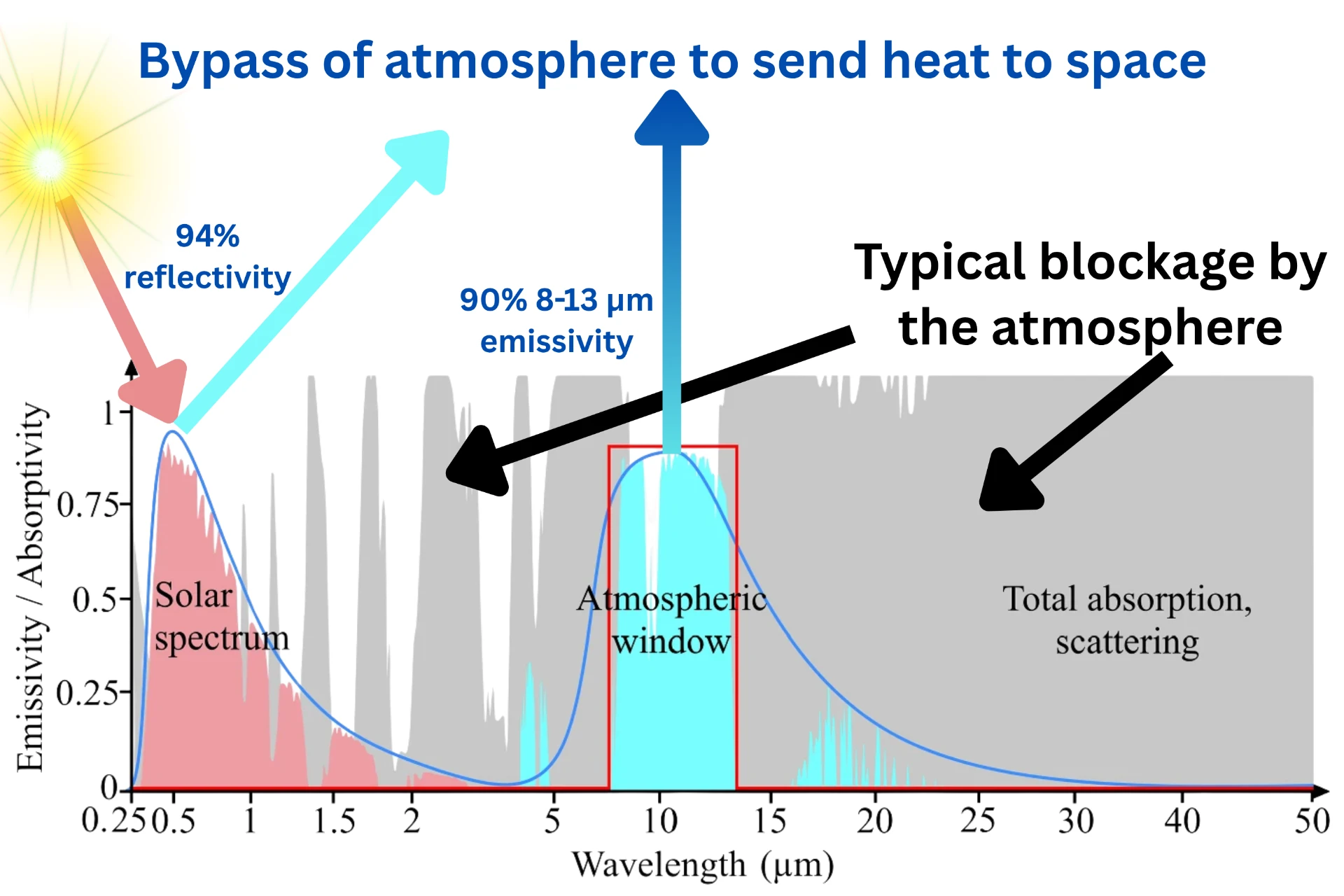
Why 8–13 µm Matters
Earth's atmosphere is mostly opaque to thermal radiation, but there's a specific window in the 8–13 µm wavelength range where radiation can pass through directly to space.
CryoPaint is specially engineered to maximize 8–13 µm emissivity in this range, meaning in the wavelengths that bypass the atmosphere, it radiates its own heat to space at 90% of the maximum rate possible.
This creates a thermal connection to the coldest heat sink available - deep space - allowing surfaces to cool below the air temperature. Heat always flows on its own from hotter things to colder things, which is the second law of thermodynamics. Space is about -454°F and sends almost nothing back, so the surface radiates away more heat than it receives.
Why Clouds Reduce Performance
Bypassing the atmosphere is only half the battle. Clouds act as thermal barriers, blocking CryoPaint's view of cold space and reducing cooling effectiveness.
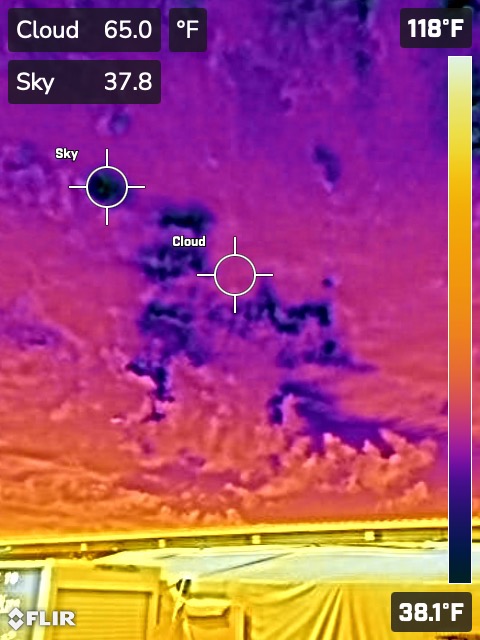
FLIR thermal image showing temperature difference between clouds and clear sky
The Cloud Problem
For CryoPaint to achieve maximum cooling, it needs a clear line of sight to space. Clouds create a thermal barrier that significantly reduces performance.
Impact on Performance
When clouds cover the sky, CryoPaint "sees" warm clouds (65°F in this image) instead of clear sky (37.8°F here), which is cold because it is open to space, dramatically reducing its ability to radiate heat away and achieve sub-ambient cooling.
The "Y" Test
Raise your arms in a "Y" shape and look up. If you see only blue sky between your hands, CryoPaint will perform at maximum efficiency. Trees, buildings, or clouds reduce performance proportionally to how much sky they block.
Why Wind Reduces Performance
Wind is one of the biggest factors in real-world performance, but the good news is that most wind speeds on most days are below 10 mph, which is where CryoPaint performs well. Convection drives the surface temperature toward the air temperature, which works directly against a coating whose entire job is to hold the surface below air temperature.
Understanding convection (the coffee cup analogy)
Blowing on a hot cup of coffee cools it down. Blowing on an iced cup of coffee warms it up. Moving air always pushes a surface toward the temperature of the air itself.
CryoPaint puts the surface below air temperature, so it behaves like the cold coffee. With very little wind, performance is excellent and the surface runs genuinely cold. The more wind you add, the more the air temperature displaces the cooling power of the coating.
Where the threshold is
The good news is that most wind speeds on most days fall below 10 mph, which is where CryoPaint performs well. 0 - 5 mph is totally fine - you are not really going to have any issues, and that is where a full 15°F below air temperature shows up on an otherwise perfect day. 5 - 10 mph is the band most days actually live in. You may see a 20% to 30% reduction when the wind is hitting the surface directly, so maybe 10°F instead of 15°F, but wind shadows and surface features often keep performance closer to full. Above 10 mph is considered an exceptionally windy day, and that is where degradation becomes significant.
Estimating wind speed with a flag
The good news is that most wind speeds on most days fall below 10 mph, which is where CryoPaint performs well. Above 10 mph is considered an exceptionally windy day. Watch a flag to know which band you are in.
Full performance
Totally fine. This is the calm condition you see on most clear days, and it is where the full 15°F below air temperature shows up.
Small reduction, still useful
Most wind speeds on most days sit in this range. Expect roughly a 20% to 30% reduction when the wind is actually hitting the surface, so instead of a full 15°F you might see something closer to 10°F. Nearby wind shadows often keep performance closer to full.
Significant degradation
Sustained wind above 10 mph is an exceptionally windy day. Convection starts winning and the surface is pushed toward air temperature. This is not a good time to judge performance - wait for calmer air before taking readings.
Short gusts do not matter much. What counts is sustained wind across the painted surface. Corrugation ridges, parapets, and wind shadows all help hold a still layer of air on the surface, which protects performance.
Wind speed is localized. What your weather app says may not match the air right where your paint is. Trees, buildings, hills, valleys, and other nearby features can improve or degrade performance depending on how much wind they add or block locally.
How to mitigate it
Anything that keeps a still boundary layer of air sitting on the painted surface protects performance:
- Corrugation ridges, which shelter the valleys between them from moving air.
- Parapets and raised edges around a flat roof.
- Wind shadows from adjacent walls, parked equipment, or rooftop units.
- Any geometry that breaks up sustained airflow across the surface.
Note that deep corrugation also blocks some sky view, so it is a trade-off - see the corrugated roof guidance in the CryoPaint Installation Guide.
Why Surface Area Decides the Result
Cooling is a rate per unit of area, not a fixed amount of cooling you get per project. CryoPaint contributes roughly -100 W/m², so the size of the coated area is the size of the cooling. Thickness helps too, but it plays a different role: a thicker coat, up to 3 oz / sq ft, squeezes the last few degrees out of a given panel, while area is what sets the total cooling. If the area is small, expect a small total effect no matter the thickness.
One surface, one heat budget
Every surface is settling a balance sheet in real time: sunlight coming in, air moving across it, heat conducted in through whatever it is attached to, and radiation leaving for the sky. CryoPaint adds the only negative one. Whether the surface ends up below air temperature depends on whether that negative term is large enough to outweigh everything else.
That term scales with area. The terms fighting it mostly do not.
What “-100 W/m²” means
Heat leaving
About one hundred, for every square meter you coat.
1 Joule per second (1 J/s), or about what a small LED night light draws
About 3 ft 3 in per side. Twice the area, twice the watts.
- minus · minus
Heat leaving
- 100 · how much
About one hundred, for every square meter you coat.
- W · watts
1 Joule per second (1 J/s), or about what a small LED night light draws
- / m² · per square meter
About 3 ft 3 in per side. Twice the area, twice the watts.
Every coated square meter sends out about 100 watts under a clear sky. A sheet of paper (8.5x11 in) is about 6 watts. A doormat, about 35. A roof, thousands.
Explore how surface area impacts cooling
If you were to have clear, calm, ideal conditions and an isolated thin metal substrate to test on, these are roughly the results you would get dependent on your surface area.
Grows with the area.
Mount and bare edges. Barely grows.
The paint works the same per square foot at every size. Small pieces spend all of it on heat sneaking in from the edges and the surface it's resting on. At 1 sq ft you get the full 15°F drop. Bigger just adds margin.
Illustrative, not a measurement. Assumes clear sky and calm air.
What to do about it
- Use a thicker coat of paint, up to 3 oz / sq ft, to get higher performance on smaller surface areas.
- Coat the entire connected surface. Contiguous metal surfaces have high in-plane thermal conductivity, so heat can transfer from an unpainted section to the painted section very easily and overwhelm it.
- If you cannot coat all of it, coat something that is thermally isolated. For example, a piece of metal the size of a magazine, and put that on a large piece of cardboard and put that outside. The cardboard separates the metal from whatever hot surface you would be resting it on.
- Give any demonstration at least a square foot of coated area. Below that factors like convection and the edges eat the net result, and no change in technique gets it back.
Building a test rig? See how to measure performance and the wind and convection guidance above.
What Happens When CryoPaint Can't See the Sky
Radiative cooling needs a clear line of sight to deep space. When a surface is vertical or surrounded by buildings, trees, or walls, that path is blocked but CryoPaint still keeps the surface from heating up. Worst-case scenario, CryoPaint remains within a few degrees of the air temperature, even in direct sunlight.
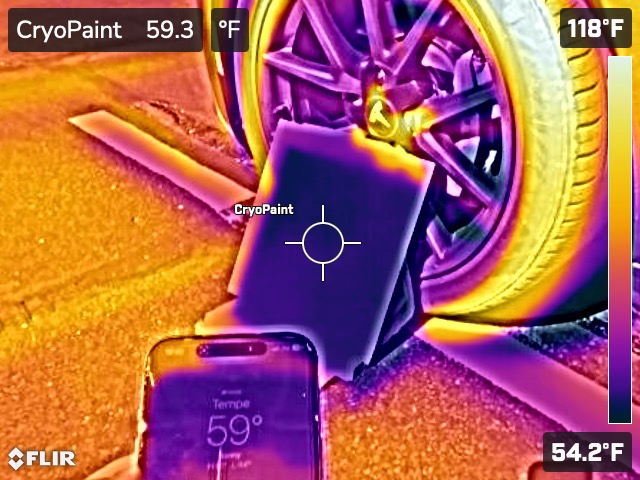
FLIR thermal image: CryoPaint on a tile, leaned at a steep angle with obstructions - surface reads at ambient
In this test, CryoPaint was placed at a steep angle with nearby buildings blocking the sky. Without the atmospheric transparency window, the radiative cooling effect is essentially turned off. The surface still stays right at air temperature because the high solar reflectivity prevents it from absorbing heat in the first place.
Without Sky View (Wall Test)
CryoPaint's high solar reflectivity alone keeps the surface at ~59°F against a 59°F ambient - right at air temperature. This is the baseline benefit of the coating: it does not heat up like a normal surface would.
With Sky View (Roof / Flat Surface)
With a clear view of the sky, CryoPaint's radiative cooling kicks in and drops surfaces up to 15°F below ambient - the full passive cooling effect.
Even in obstructed conditions, CryoPaint keeps a surface from heating above air temperature. Give it a clear sky view and it can go well below it.
What "sky-facing" actually means
Sky view is judged from the surface's point of view, not yours. Stand where the coating is, look outward the way it is pointing, and estimate how much of that view is open sky versus ground, trees, walls, parked equipment, and rooftop units. Sky is the cold heat sink. Everything else is a warm object radiating heat back at the coating.
A flat surface pointed straight up sees almost nothing but sky, which is the full effect. Tilt it toward the horizon, or lean it against a wall, and most of its view fills up with ground and structures. That is why the same coating on the same day can read up to 15°F below air temperature on a roof and right at air temperature on a wall.
CryoPaint and Insulation
Insulation and CryoPaint do opposite jobs. CryoPaint is an active cooler while insulation is a thermal bottleneck. Use them together correctly and you get a thermal chimney. Use them incorrectly and insulation blocks the very cooling you are trying to achieve.
Insulation does not remove heat
Insulation only slows heat movement. An insulated roof with no coating is still a positive number, roughly +7 to +20 W/m² instead of the +250 W/m² or more of bare metal. And this is a theoretical number, not accounting for any gaps in the insulation itself. Insulation also stores heat and keeps releasing it long after the sun has set. Because insulation resists flow in both directions, that heat cannot leave the way it came in. It accumulates.
CryoPaint is an active cooler
CryoPaint cools the roof surface itself at roughly -100 W/m². CryoPaint delivers the most on a bare, uninsulated roof with nothing in the way. Additionally, the more surface area you can give CryoPaint, the more cooling power it will have. Additionally, a thicker coat of CryoPaint improves the cooling performance even more.
The thermal chimney
The thermal chimney effect is where the heat coming in through the sides and the bottom of a box is limited, but heat is able to leave through the roof. This allows the interior to be naturally cooler than other designs. This can be done by CryoPainting or insulating the sides, and then using only CryoPaint on a conductive metal roof. Any heat that comes in through the side is limited and naturally convects to the ceiling, which gets absorbed into the cold CryoPaint metal and then sent to space.
4 insulation configurations and how they affect heat flow for illustrative purposes
CryoPaint Simulator
Explore this interactive simulator to see how passive daytime radiative cooling works on roofs and buildings under different conditions.
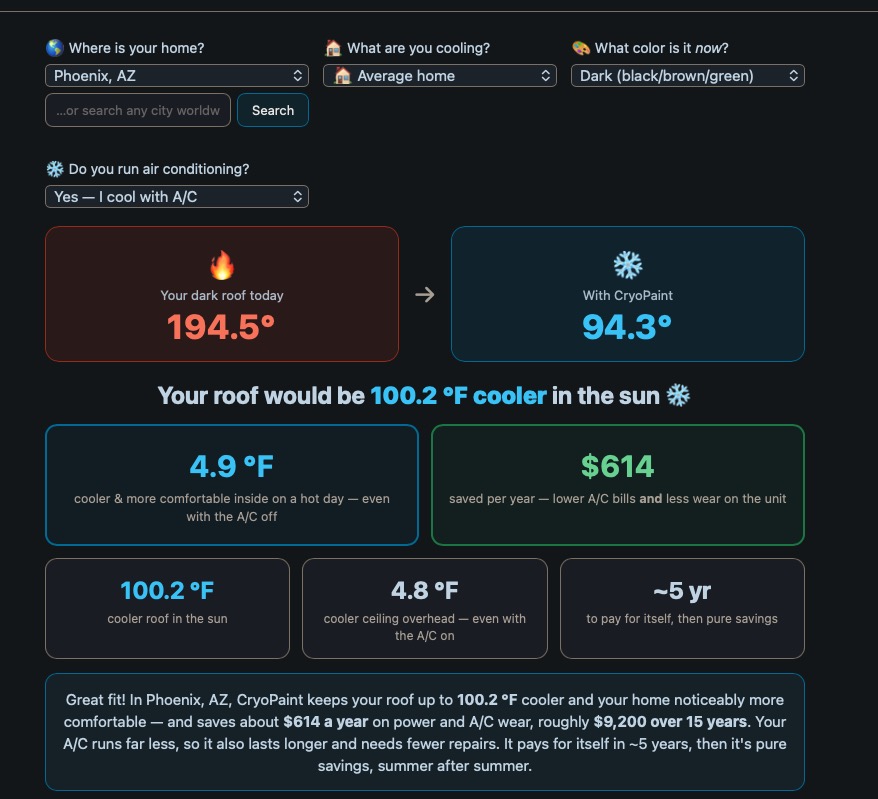
Roofing & Building Simulator
Compare roof temperatures, indoor comfort, and energy savings for different surfaces and colors in your location.
Experimental Note: This simulator is experimental and for educational purposes only. It may not reflect actual real-world performance. Results can vary based on environmental conditions, application methods, and surface properties.
See CryoPaint in action
Explore real-world applications and case studies.